
The Best Wegovy and Mounjaro Injection Sites For Successful Weight Loss Results
Introduction
It takes a lot of heart to start a new weight loss journey, especially if you have been down this road a few times already. If you have just received your first delivery of Wegovy or Mounjaro, this time you have clinically-proven support to help you achieve your goals.
You might be experiencing mixed feelings about taking your first step: excitement for the new, healthier you and nerves if you’ve never self-injected before. This is to be expected.
Hopefully, you will have already watched video tutorials on injection technique and read the patient information leaflet enclosed with your prescription. This is the perfect place to start. If you haven’t, then please take time to visit the following:
- Injection Pen Demonstration (YouTube)
- Patient Information Leaflet (Wegovy)
- Patient Information Leaflet (Mounjaro)
However, even when you are well prepared, it’s difficult to escape all the conflicting, confusing advice on platforms like TikTok and Reddit. Some GLP-1 users are convinced that injecting into the stomach makes the weight drop off faster. Other social media influencers claim the thigh is the secret to avoiding nausea.
Don’t worry.
At Medy, our role is to bring you guidance based on the actual science behind injection sites to help you feel completely confident in your technique and supported as you get started.
Where Should You Actually Inject?
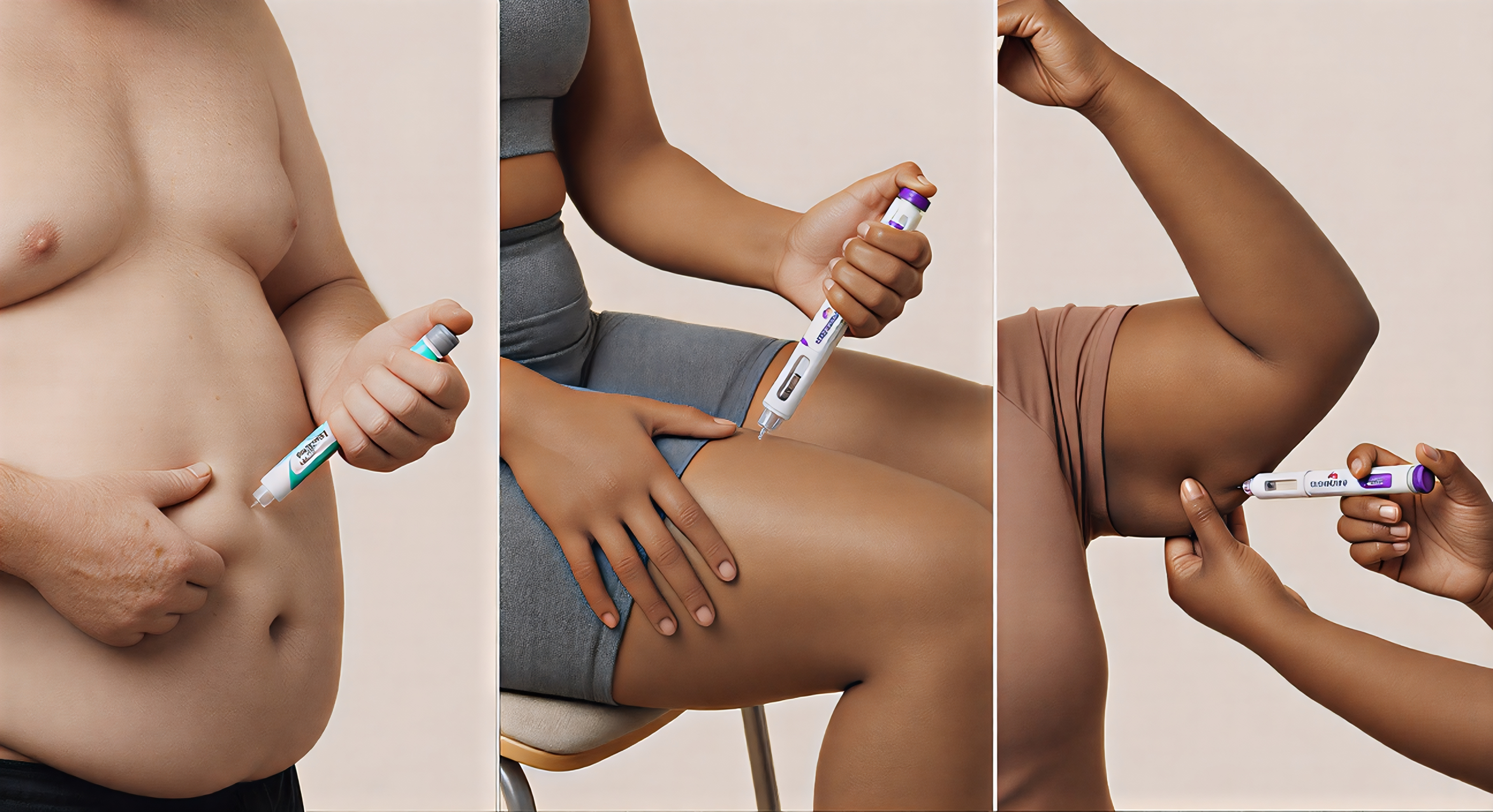
Based on official guidance, both Wegovy and Mounjaro are designed to be injected into the fatty layer just below your skin (subcutaneous fat). You are not aiming for a vein or a muscle but for the soft, pinchable layer of fat.
The manufacturers of both medications recommend three main areas for subcutaneous injection:
1. The Abdomen (Stomach)
Many patients favour injecting into their stomach because it is easy to reach and usually has a good amount of subcutaneous fat that you can pinch with one hand whilst you inject with the other.
However, be aware of the following "no-go" zones for the best technique:
The Belly Button: It is important that you stay at least two inches (about 5cm) away from your belly button. This helps to make sure you are injecting into soft fat, and not tougher tissue, to minimise any discomfort.
Abdominal Scarring: This is important advice that is often missed. If you have had previous surgery on your stomach, such as a Caesarean section, keyhole surgery (laparoscopy), gallbladder (cholecystectomy) or appendix removal (appendectomy), you need to be careful around the scars.
Scar tissue is different from normal skin and fat in composition. Instead of being soft, it is often tough and fibrous. If you inject directly into a scar or very close to it, you may find the needle insertion slightly painful. More importantly, scar tissue does not have the same blood supply or absorption qualities as healthy fatty tissue. This means you may not absorb the full dose of your medication, making it less effective. Always aim for the soft areas at least a finger-width away from any visible scars or indentations.
Bruises: It is also sensible to steer clear of any bruises or purple patches, as these areas are already tender and injecting here can be unnecessarily painful.
2. The Thighs
This is another very accessible spot, making it straightforward to inject by yourself. It is easy to see exactly what you are doing, which can be very reassuring when you are first starting out on GLP-1 treatment. Aim for the fleshy middle part of the front of the thigh, as this is usually where the best fat layer is found, and it makes sure you are safely away from any blood vessels.
3. The Upper Arms
This is a great injection site, but it can be trickier to reach on your own. Aim for the fleshy back part of the upper arm. This is the area where we often worry about "bingo wings" and not the shoulder muscle itself (where you may have received a flu jab in the past). You may need the assistance of a partner or friend to gently pinch the site whilst you press the plunger. If you are injecting solo, the stomach or thighs are usually much easier to manage.
The Social Media Debate: Stomach vs Thigh
If you have scrolled through social media lately, you have probably seen the "Stomach vs Thigh" debate. It is a highly debated topic within the GLP-1 user community.
If so, you are likely to have come across rumours that injecting into your stomach brings maximum weight loss, but switching to your thigh helps if you feel sick.
You may wonder whether there is any truth to these claims or whether they are just a myth.
The Science of Absorption
There is actually a tiny grain of scientific truth to the claims, but it is often wildly exaggerated online.
Eli Lilly carried out a small study of 54 volunteers to look at how the body absorbs Mounjaro from different sites. Results show that the absorption can be ever so slightly faster when injected into the stomach compared to the arm (second fastest) or the thigh (slowest).
What This Means
Because the stomach area has a rich blood supply, the medication might get into your system a fraction quicker when injected here. It is possible that this faster peak in GLP-1 levels could lead to slightly stronger appetite suppression for some people. However, the quicker absorption might also trigger a sharper wave of nausea if you are sensitive to the side effects.
On the other hand, injecting into the thigh might offer a slightly slower, steadier absorption. This may explain why some users report feeling less nausea when they inject into their thigh.
The main takeaway is that overall absorption of GLP-1 medicine is the same from every site. Whether you choose your stomach, thigh or arm, your weight loss results will not be affected.
When you see a TikTok influencer claiming they have lost 2kg in a week by switching from their thigh to injecting into their stomach, take this with a large pinch of salt. Many other factors influence results: hydration, menstrual cycles, salt intake, and activity levels all change the number on the weighing scales far more than the injection site does.
You should expect to lose varying amounts of weight from one week to the next and even to experience temporary plateaus along the way. Nobody has a linear weight loss journey.
The Verdict: If you are struggling with nausea, there is no harm in trying your thigh to see if it helps settle your stomach. But do not worry that you will "lose less weight" by doing so. If you see no difference, simply stick to what works best for you.
Simple Steps To Perfect Your Technique
Good injection technique is much more important than your choice of injection site, and it is key to get this right so that your medication is delivered safely and works effectively.
Step 1: Injection Temperature
Some people are sensitive to injecting cold medication and find it can sting a little. If this is the case and you usually store your pen in the fridge, try taking it out 15 to 30 minutes beforehand. Allowing it to reach room temperature before injecting can reduce any discomfort.
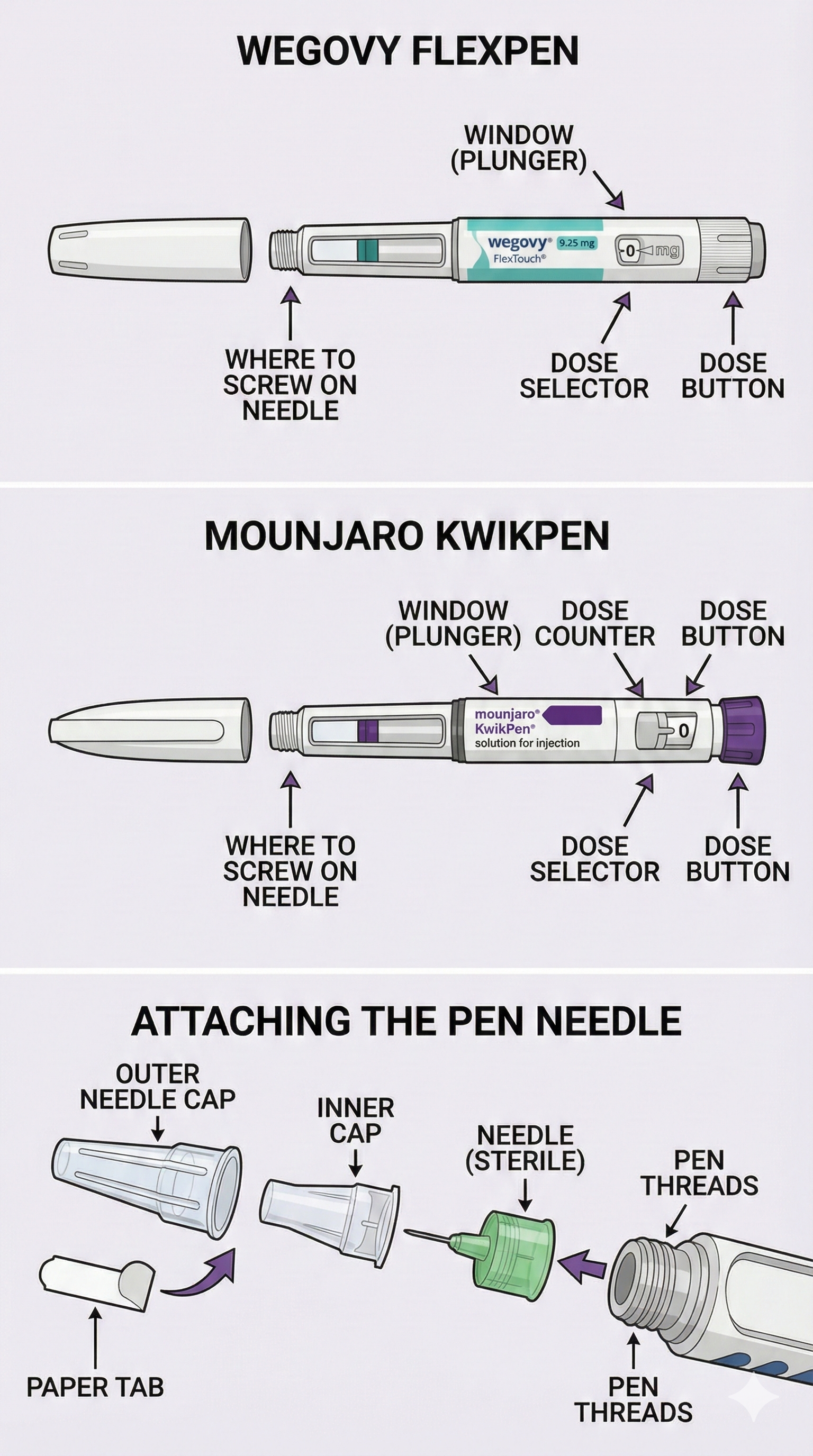
Step 2: Check Pen and Attach a New Needle:
Always remember to check the liquid inside the pen chamber when you remove the cap. It should be clear and colourless, with no crystals. Do not inject if this is not the case. Instead, contact the Medy clinical team for advice. For Mounjaro, it is advised to swab the inner seal of the pen before attaching a needle.
Remove the protective paper tab and twist the needle onto the pen securely before taking off both outer and inner caps.
Never reuse a pen needle for the following reasons:
- Infection risk - you could introduce microbes into your body and put your health at risk. They are sterile for single use only.
- Needle blunting - although it may still look sharp, needles become blunt and can even bend after use. The lubricant coating also wears off. This means reusing them could make the next injection uncomfortable, as you could tear the skin instead of gliding through it.
- Leaving a needle attached to your pen can cause damage to the mechanism, leakage (and wastage of medication), air bubbles or crystallisation inside the needle.
- Reusing a needle can cause fatty tissue to harden or become lumpy (lipodystrophy). Not only can this look and feel unpleasant, but it can also reduce absorption, meaning your medication will become less effective in the future.
Step 3: Prime Pen and Dial the Dose
Follow the leaflet provided with your pen to prime it, as advice can differ depending on your device. Priming checks that the needle is not blocked or bent, and that the medicine can flow through it freely.
Turn the dial until the specific full dose you have been prescribed is displayed (often the maximum turns). Never attempt to 'count clicks' for partial doses, as this goes against manufacturer guidance.
Step 4: Prepare Your Injection Site
Wash your hands with soap and warm water. Choose your site for the week. Whilst not necessary, if you choose to wipe it over with an alcohol swab, make sure you let it dry completely before you inject. If the alcohol is still wet, it might sting.
Step 5: Pinching
To be sure you are injecting into fat and not muscle, you can gently pinch a soft area of skin between your thumb and index finger. You do not need to squeeze hard, but just lift the skin slightly away from the muscle underneath.
Step 6: Inject
- For Wegovy (Flexpen): Press the pen firmly against your skin, at a 90-degree angle. Keep holding it down firmly until the plunger has completely depressed. You may hear a click when the injection is almost done. Count to 6 slowly before you lift the pen.
- For Mounjaro (KwikPen): Insert the needle into your skin at a 90-degree angle. Press the dose button down and hold it. Hold the plunger until it has fully depressed to ensure the full dose is delivered. Count for 5 to 10 seconds, then gently lift the pen away.
Troubleshooting
It is perfectly normal to worry over your first few weeks of injecting, that you haven't done it right. You may find the following guidance on some common situations helpful for you to refer back to throughout your GLP-1 weight loss journey.
"Golden Rule: If you are worried that maybe you have had the full dose, do not inject again to compensate. Taking too much medication can cause serious side effects. It is always better to wait for your next scheduled dose. You can also contact the Medy clinical team for advice.
Scenario 1: Liquid is present on the skin after removing the needle
You notice liquid on your skin or a drop hanging from the needle after injecting.
Did it work? Likely, yes. It's common to see a small droplet at the needle tip. But if medication is running down your skin or the injection site feels wet, some liquid might have leaked. This can happen if you remove the needle too fast.
Action: Do not re-inject, as you have more than likely received most of the dose. Dispose of your pen needle safely and wipe the injection area clean. Stick to your usual schedule for the next dose. If you are worried that a significant amount leaked out, contact our clinical team for advice.
"Tip: Hold the pen firmly against the skin and keep the button pressed down for the full count (usually 5–10 seconds) before removing the needle slowly and gently. Don’t rush.
Scenario 2: The Dose counter didn't return to '0'
The dose selector window did not return all the way to the '0' position when injecting, or it got stuck partway.
Did it work? No, you have probably not received the full dose.
Action: Remove and dispose of the needle safely. Do not try to force the pen or re-inject. Contact the Medy clinical team to report the issue and ask when it’s safe to try again with a fresh needle or replacement pen.
Scenario 3: You didn't feel anything
You used the right technique, but didn't feel the needle, and there's no mark.
Did it work? Highly likely. Pen needles are very fine, so it's usual not to feel anything.
Action: Check the pen. If the dose dial is at '0' and the plunger has moved, you can assume the medication was delivered. Do not take another dose.
Scenario 4: Bleeding at the injection site
You notice bleeding (more than a tiny drop) after injecting.
Did it work? Yes, likely, but you may have caught a small blood vessel near the skin’s surface.
Action: Don’t worry. Apply gentle pressure with a clean tissue or cotton ball for a few minutes. The bleeding should stop. Use a plaster if needed. If bleeding continues or the area is painful, swollen, or hot, get medical advice.
Why You Must Rotate Injection Sites
Even if you find a preferred site that is easy to reach and gives you confidence that you have injected correctly, you must not use the exact spot every single week.
If you repeatedly inject into the same tiny patch of skin, like reusing a pen needle, it can cause lipodystrophy. Injecting into hard, lumpy tissue can reduce the effectiveness of your medicine.
A Simple Rotation Plan
Imagine your stomach is a clock face.
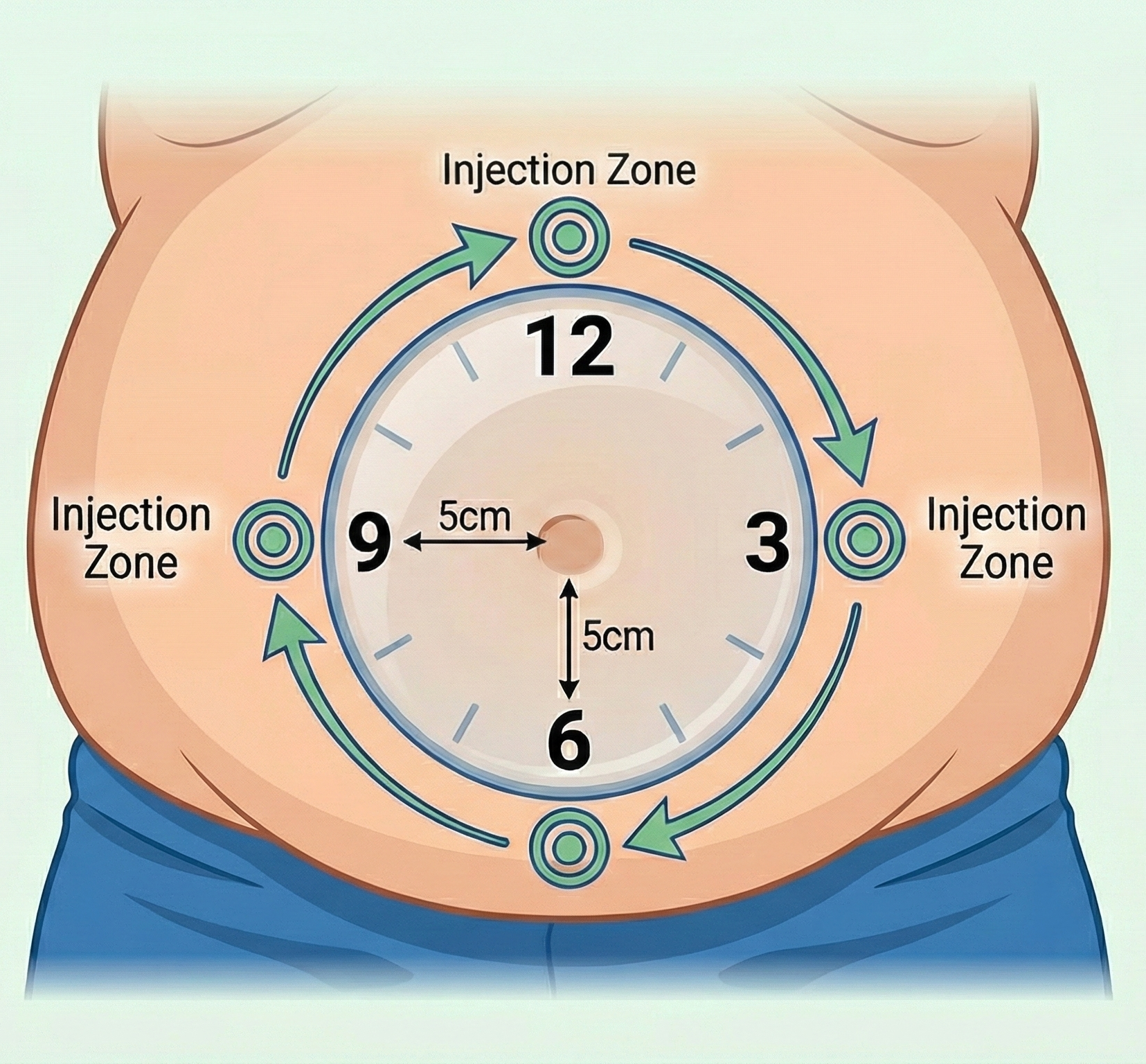
- Week 1: Inject at 12 o'clock.
- Week 2: Inject at 3 o'clock.
- Week 3: Inject at 6 o'clock.
- Week 4: Inject at 9 o'clock.
Alternatively, simply swap sides.
- Week 1: Left side of the stomach.
- Week 2: Right side of the stomach.
- Week 3: Left thigh.
- Week 4: Right thigh.
As long as you are moving it around by a few centimetres each time, you are doing it right.
Safe Disposal
Once you have finished your injection, safety comes first. Never throw loose needles or injection pens (which contain glass) into your general household rubbish, as it could hurt people at home or waste handlers.
You should have been provided with a yellow sharps bin. Place your used needles or pens straight into this bin. When it is full to the fill line, seal it and arrange for collection according to your local council or pharmacy guidelines. Keeping these out of the general waste protects refuse workers and the environment.
Summary
The "best" places to inject are the sites that work best for you, as long as you rotate them weekly.
- The stomach is usually easiest. Remember to avoid your belly button and any scars or bruises.
- If you struggle with feeling sick, try the thigh.
- If someone can help, you can inject it into your arm.
Your weight loss is your own journey. Social media can be useful for finding a like-minded community and support, but remember that it is not always reliable.
Referring back to our Patient Welcome Pack or Knowledge Hub and speaking with our clinical team at Medy will always give you the most accurate advice. Trust the process, be patient with yourself, and celebrate every step forward, including the non-scale victories.
If you aren’t sure about your technique or are struggling to manage side effects regardless of where you inject, reach out to our clinical team. We’re here to help.
References
Effect of Injection Site on the Relative Bioavailability of a Single Dose of Tirzepatide in Subjects With Low and High Body Mass Indices. ClinicalTrials.gov Identifier: NCT04050670. Results posted 24 March 2023, accessed 5 January 2026. ↩
Electronic Medicines Compendium (eMC). Wegovy® (semaglutide) solution for injection in pre-filled pen. Patient Information Leaflet. electronic Medicines Compendium. Updated 23 December 2025, accessed 5 January 2026.↩
Electronic Medicines Compendium (eMC). Mounjaro® (tirzepatide) solution for injection in pre-filled pen. Patient Information Leaflet. electronic Medicines Compendium. Updated 18 December 2025, accessed 5 January 2026.↩